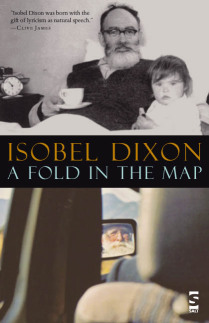
About A Fold in the Map:
One of my favourite books, Jan Morris’s Trieste and the Meaning of Nowhere, inspired the title of my second collection, A Fold in the Map. In her book, which resonates somewhere between history and travel book, Jan Morris meditates on the city and so much more, using the title phrase to describe the in-betweenness of travellers – something I feel very strongly.
This feeling comes through in the first half of my collection, where many poems were written looking back to South Africa from Scotland and England, to the climate and people and creatures I still miss.
The second half – after the ‘fold’ in a way – is about a person I miss very much indeed, at a distance that can’t be changed by a long-haul flight. My father, asthmatic and often ill, but unfailingly cheerful, died in 2002, and the poems here are about him, his illness and death, and of course also about my four sisters, and my mother, the women who loved him.
Originally published in 2008, Nine Arches re-issued this very personal collection in July 2018. Read more or acquire a copy from the Nine Arches site here.
Praise for A Fold in the Map:
‘Understated … powerful … Isobel Dixon's A Fold in the Map includes a poignant retelling of her father's illness and decline ... Dixon's own graceful style provides soothing contrast to the bewilderment and indignity her father suffers.’ – Nathalie Whittle, Financial Times
‘A profoundly moving and engaging collection of poems.’ – Gwen Podbrey, SA Jewish Report
‘Isobel Dixon was born with the gift of lyricism as natural speech. A measure of her accomplishment is that all the sense impressions of Africa, even if the reader has never actually been there, live naturally in her poetry as if it were the only landscape. The vivid surroundings of her childhood got into her rhythms and her phrases. A second, perhaps sadder story, springs from that. She is looking back to something lost, even as she continues to engage in the history of the land where she was born. She has the language for her political situation, too, and for a third story, about her father’s death, she has the language of deep grief – a longing, beyond mere nostalgia, for both a childhood and a homeland.’ – Clive James
‘When my father died a few years ago I was totally inconsolable and found comfort only in books – especially books of poetry such as Isobel Dixon’s A Fold in the Map, in which she writes about the death of her father.’ – Grethe Fox, Femina
‘Another lyrical voice is Isobel Dixon, whose A Fold in the Map has a powerful section charting the illness and death of her father.’ – Elaine Feinstein, The Times Christmas Choice 2007: The year’s most sublime verses’
‘[Poetry] evoking the textures and shapes of this country ... calling up simple but potent memories of family life. ... The freight of memory and love and loss coalesce into profoundly moving elegy; these are "stigmata for my father / and his panel-beaten heart". – Shaun de Waal, Mail and Guardian
‘Weather Eye is a finely crafted evocation of place and intimacy; while A Fold in the Map is a poignant and delicately controlled tribute to memory and to family. Both collections moved and challenged and excited me with their honesty and courage.’ – Kobus Moolman, LitNet
‘Isobel Dixon’s gift is to bring the same exactitude to the rendering of physical detail as she does to the awesome pit-face of human grief. The intimate details of her personal history are reported with congeniality and with admirable control.’ – Tim Liardet
‘One of the finest South African poets writing today - the power of her work lies in her distinctive voice. Dixon's remarkable work that chronicles her father's illness and death brings to mind Margaret Atwood's poems written for her own dying father.’ – Kylie Thomas, Mail & Guardian
‘A Fold in the Map is a steady next step in this interesting new poet's career. Most striking is Dixon's penchant for short powerful bursts of insight or reflection. She knows when enough is enough and the word choice of her free verse often commands some powerful imagery. This is a modern poet in fine command of her art.’ – Dan Szczesny, The Hippo (USA)
‘Dixon returns with fresh energy and insight to familiar themes such as journeys, family, or self-discovery, also beautifully reflected in the personal cover photographs. As becomes apparent, many of these poems, overtly focused on intimate and individual experiences, do not lack a broader socio-historical dimension, most strikingly expressed in 'Back in the Benighted Kingdom'. With a precision reminiscent of Szymborska, Dixon evokes here the nostalgia for a mosquito skin bump to hint at colonial, 'quieter, subtler ways / of drawing blood.' What characterises Dixon's poetry most poignantly is its accessibility, which should not be mistaken for simplicity. Written in free verse, her work exudes ease and unpretentiousness. Dixon is fully in command of the poetic tools at her disposal. In her hands form and content intertwine naturally, never allowing the reader's attention to wane. Intelligent and sensuous, Dixon's poetry has the wonderful quality of being able to hold the essence of a variety of moods, places and people, which many readers, whether poetry lovers or not, will find engrossing.’ – Karina Magdalena Szczurek, Sunday Independent (South Africa)
‘Isobel Dixon’s A Fold in the Map was also excellent … It needs to be read in one go and it really rewards the reader if you read it like a novel from start to finish. Isobel Dixon's a real talent I believe, and these poems are highly impressive for their emotional truth, and the élan and love with which she writes about her father. You end up liking the poet a lot after reading this book, which is too rare an event in poetry.’ – David Morley, Christmas Selection 2008
‘A surprisingly diverse selection of work. Dixon's most powerful tool, her dexterity at utilising metaphor. A significant voice within the milieu of South African poetry. She shows herself to be just as capable of unfolding the intricacies and inherent beauty of the South Africa of her childhood as she is of fearlessly confronting the brooding dread that inhabits the darkest corners of that very same landscape.’ – Greg Cahl, New Contrast
Quisque iaculis facilisis lacinia. Mauris euismod pellentesque tellus sit amet mollis.